Automated Slack Standup Summaries That Work
Automated Slack standup summaries replace status calls with clear daily updates, visible blockers, and a workflow teams can actually control each workday.
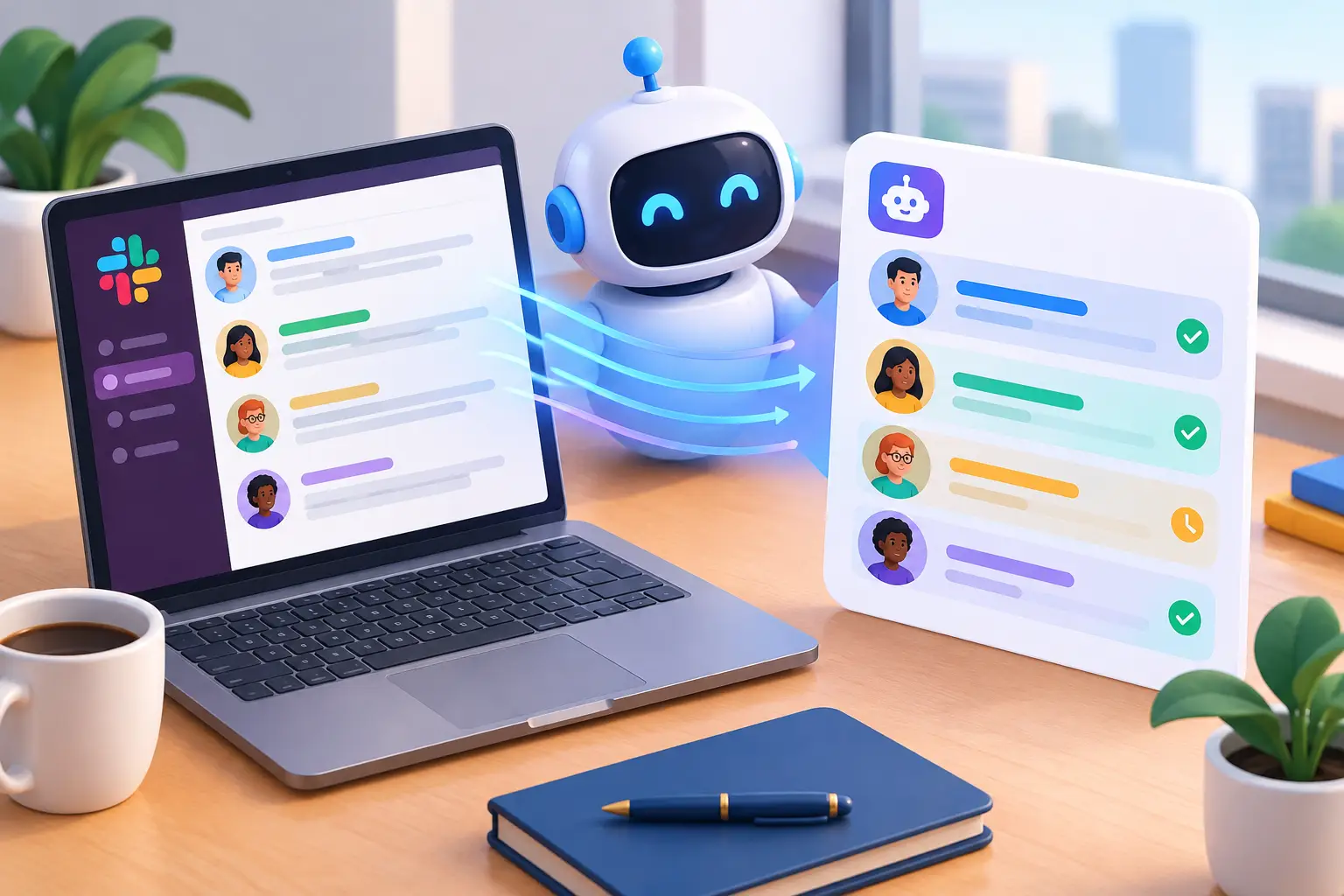
A daily standup stops being useful the moment it becomes a meeting people attend to prove they are working. The familiar routine is expensive: a dozen people interrupt focused work, wait for their turn, and hear updates that matter to only two people. Automated Slack standup summaries offer a better default when the real goal is visibility, not attendance.
The mechanism is straightforward. Each person receives a private prompt in Slack, replies when their workday allows, and the team gets a concise summary in the agreed channel. No calendar shuffle. No time-zone penalty. No second system to remember.
But automation alone does not make a standup good. A badly designed workflow can turn into another stream of vague updates that nobody reads. The difference comes down to the questions, the summary format, the handling of blockers, and who controls the ritual.
What automated Slack standup summaries should do
A useful async standup captures the small amount of information a team needs to coordinate: what moved, what is next, and what may stop progress. It should not ask employees to write a daily performance report. That distinction affects both response quality and trust.
The strongest workflows collect updates through direct messages rather than asking everyone to post manually in a shared channel. A DM prompt gives each person a clear moment to respond without filling the team channel with fragments. The published summary then becomes the shared record: readable by managers and teammates, but compact enough that people can scan it between real work.
Timing also matters. A team spread across the US, Europe, and Asia should not pretend there is one reasonable morning. Prompts need to fit local working hours, while summaries should make updates visible without requiring everyone to be online at the same moment. Async does not mean less accountable. It means the record is available when people can use it.
Good summaries also preserve context. If someone reports a blocker, it should be obvious who owns the work and what kind of help is needed. If an item is complete, the team should be able to see momentum without searching through yesterday's chat history. Over time, recurring blockers and completion patterns become operational signals, not anecdotes brought up too late in a retrospective.
Start with questions people can answer honestly
The default three-question standup is common for a reason: yesterday, today, blockers. It is also easy to make useless. "Worked on the project" and "Continue working on the project" technically answer the prompt while telling the team almost nothing.
Use prompts that fit the team's work. An engineering group may ask what shipped or changed, what is planned next, and whether anything needs a decision or review. A product team may focus on customer learning, decisions due, and dependencies. Operations teams may care more about requests completed, exceptions, and risks. The structure can stay consistent while the language matches the job.
Keep the number of questions restrained. Daily check-ins are for coordination, not documentation. If every response requires a mini project update, people will either rush it or resent it. Detailed plans belong in the systems where the work is actually managed.
It also helps to state what does not belong in a standup. Avoid requiring estimates for every task, explanations for slow progress, or a list of hours worked. Those questions shift the ritual from coordination toward surveillance. Teams can discuss performance when necessary, but hiding that process inside a daily bot prompt is not a healthy shortcut.
Design the channel summary for scanning
A summary should answer a simple question in under a minute: does anyone need attention today? That means the channel post needs less decoration and more signal.
Group updates consistently, identify the person attached to each update, and make blockers easy to spot. A readable summary lets a product lead notice a dependency waiting on legal review, an engineer see that a pull request needs eyes, or an operations manager catch a recurring vendor issue. The purpose is not to create a public ledger of activity. It is to make intervention possible before work drifts.
There is a trade-off here. Posting every answer verbatim offers maximum detail, but it can create a long, noisy channel post. Compressing too aggressively can erase useful context. For most teams, short individual entries with clear blocker language are the practical middle ground.
Choose the destination channel with the same care. A small delivery team may want its own channel. A company-wide standup channel can work for a very small organization, but it often becomes unreadable as headcount grows. Separate rituals by team or function when their work has different audiences and dependencies.
Treat blockers as a workflow, not a label
Many standups ask about blockers. Fewer teams have a reliable response when someone says yes.
A blocker should trigger a next step: a person to contact, a decision to request, a thread to continue, or a work item to update. If the summary only displays the word "blocked," the team has documented a problem without reducing it. That is better than silence, but not by much.
Managers have a particular responsibility here. Do not wait for the next scheduled planning session if a daily update exposes a dependency. Respond where the update appears, clarify the owner, and close the loop when the issue is resolved. People will keep reporting real risks when they see that the ritual produces help rather than unwanted scrutiny.
Repeated blockers deserve a different response. One stalled review may be ordinary. The same review bottleneck appearing every week is a process problem. Automated summaries make those patterns easier to notice because the information is collected in a consistent form. The useful question is not "Why did this person get blocked again?" It is "What part of our system keeps creating this delay?"
Give teams control over the ritual
Standup software often assumes every team should run the same schedule, prompts, and channel behavior. That is convenient for the vendor, not necessarily for the organization.
Teams need room to configure how their check-ins work. Some groups need daily updates; others need them only on workdays or during a project phase. Some need a lightweight blocker question; others need structured progress prompts. Administrators should be able to control features at a granular level instead of granting broad, all-or-nothing access just to let a team lead adjust a routine.
Data control matters too. A status update can contain customer details, employee concerns, or delivery risks. Organizations should understand where that data lives, who can administer the workflow, and whether they have a practical path to operate the system themselves. Convenience is not a reason to accept permanent loss of control.
Morgenruf takes a deliberately narrow approach: it collects async check-ins through Slack direct messages, publishes concise channel summaries, and surfaces blockers and completion trends. It is available as a permanently free hosted option, with no per-seat pricing, and can also be self-hosted with customer-controlled Postgres data. Its MIT-licensed codebase is relevant for teams that need an auditable deployment path, not just another promise about privacy.
Avoid the common failure modes
The first failure is replacing a meeting with a longer written meeting. If people are expected to read every update, respond to each one, and provide status detail for multiple audiences, the async version will become just as disruptive. Keep the ritual narrow and let deeper discussions happen in threads or in the work system that owns the task.
The second is treating nonresponses as a character flaw. People miss prompts because they are in incident work, customer calls, travel, leave, or concentrated work. A missed check-in may need a follow-up, but it should not automatically become public pressure. The goal is dependable team awareness, not perfect bot compliance.
The third is using summaries as the only source of truth. Standups are a coordination layer. They do not replace project plans, tickets, decision records, or one-on-ones. Asking them to do all of that guarantees clutter.
Finally, do not confuse visibility with management. Automated summaries can show where attention may be needed. They cannot explain every delay, settle priorities, or build trust by themselves. Those still require judgment and direct conversation.
A well-run async standup gives people their time back while making the work easier to see. Start small, make blockers actionable, and adjust the prompts when the team stops learning from them. The best sign that the workflow is working is not a perfect response rate. It is fewer surprises and fewer people sitting through a call they never needed.
Morgenruf collects standup answers by Slack DM and posts the summary to a channel with blockers called out, with no per-seat pricing: Quick start on GitHub.